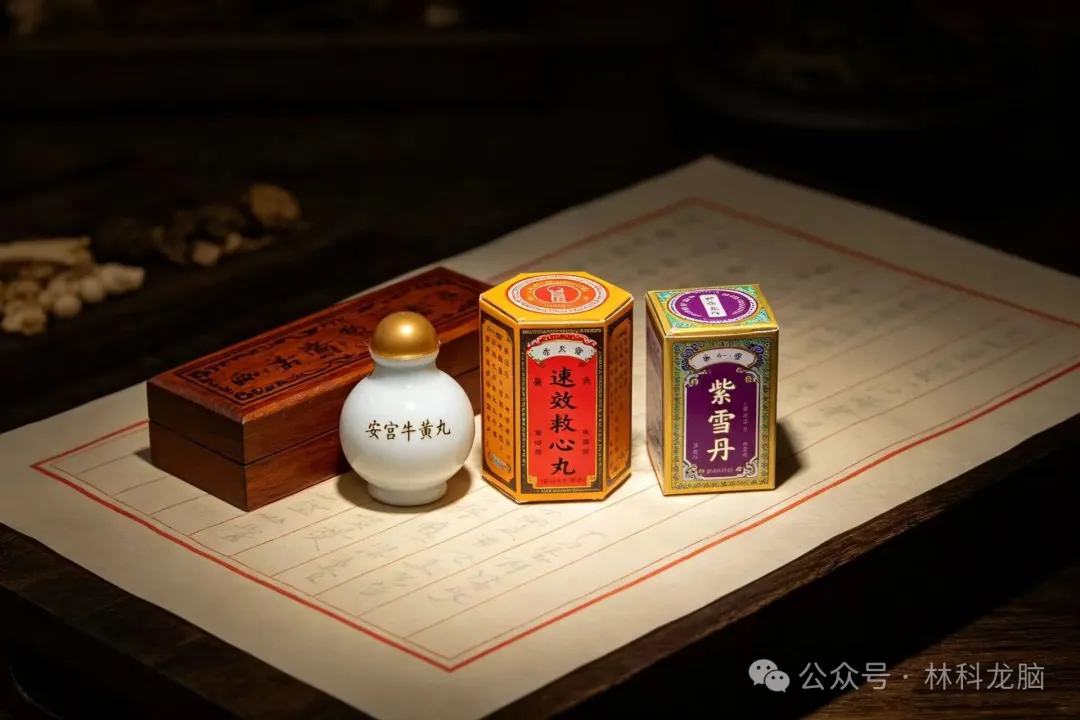
Angong Niuhuang Pills, Suxiao Jiuxin Pills and Zixue Dan – in these time-honored classical prescriptions passed down for thousands of years, there is one medicinal herb that always serves as the core ingredient guiding medicines directly to the lesion site: natural borneol.
As an indispensable component of the "Three Cold Resuscitation Formulas", natural borneol boasts unique medicinal effects including unblocking all orifices, dissipating stagnant fire, reducing swelling and alleviating pain, playing an irreplaceable role in treating critical and severe illnesses.
Nevertheless, not all borneol products available on the market live up to their names. There exists an essential distinction between natural borneol (also known as natural borneol flakes) and synthetic borneol (also called synthetic borneol flakes). Natural borneol consists purely of d-borneol with no isoborneol, delivering remarkable efficacy with mild and safe properties. In contrast, synthetic borneol contains high levels of isoborneol, featuring far weaker medicinal effects and certain irritant properties. Though differing by merely one adjective, the two are worlds apart.
For this very reason, natural borneol is widely formulated into dozens of classic Chinese patent medicines, holding an unshakable core position within the traditional Chinese medicine system.


The medicinal application of natural borneol dates back around two thousand years. Shennong’s Classic of Materia Medica, China’s earliest monograph on Chinese herbal medicine, classifies borneol as a top-grade medicinal herb, recording that it “treats red eyes and corneal opacities, and improves eyesight”. This proves physicians already regarded it as a precious medicinal material during the Qin and Han dynasties.
From the Tang and Song dynasties onward, natural borneol became a rare herb cherished by imperial courts and physicians of all ages. The Tang official pharmacopoeia Xinxiu Bencao (Newly Revised Materia Medica) offered more detailed accounts of borneol’s producing areas and physical properties, while the Song work Zhenglei Bencao (Classified Materia Medica) documented its medicinal merits. In the Ming Dynasty, Li Shizhen named borneol “piannao (flake borneol)” in his monumental Compendium of Materia Medica, systematically recording its nature, flavor, efficacy and administration methods. He noted that it “unblocks all orifices, dissipates stagnant fire, removes corneal opacities and brightens vision”, an entry that remains a vital reference for the medicinal use of natural borneol to this day.
Within imperial courts through successive dynasties, natural borneol was revered as an extremely valuable tribute and exclusive imperial medicinal ingredient. The Tang court regularly blended borneol into incense and herbal prescriptions to refresh the mind, unblock orifices, dispel foul turbidity and detoxify the body. Many renowned formulas compiled in the Song Taiping Huimin Heji Ju Fang (Imperial Grace Formulary of the Taiping Era) feature borneol as a key compatible herb. During the Ming and Qing dynasties, natural borneol evolved into one of the core components of the “Three Cold Resuscitation Formulas” — Angong Niuhuang Pills, Zixue Dan and Zhibao Dan — delivering an irreplaceable therapeutic effect in emergency treatment of warm-heat diseases. Physicians throughout history held natural borneol in high esteem, describing it as “aromatic and penetrating, reaching every corner of the body”. Capable of guiding other medicinal ingredients straight to affected lesions, it serves as an indispensable medicinal messenger herb in countless prescriptions.
Natural borneol was extraordinarily scarce in ancient times, giving rise to the old saying: “One flake of borneol costs one tael of gold”. Starting from the Tang and Song dynasties, natural borneol was imported to China via the Maritime Silk Road from regions such as Sumatra, Indonesia, ranking alongside ivory, rhinoceros horn, frankincense and myrrh as prized overseas rarities. Due to scarce resources of borneol trees, remote origins and complicated harvesting and processing techniques, natural borneol flakes were priced far higher than gold for centuries, accessible only to imperial royalty and wealthy merchants. The Ming travelogue Yingya Shenglan (Overall Survey of the Ocean’s Shores) records that borneol was “priced by the tael and more costly than gold” in overseas trade, vividly illustrating its extreme rarity. This situation where natural borneol was virtually unattainable even at a high price persisted well into modern times.


Historically, the supply of natural borneol had long relied on imports from overseas. It originally grew in Sumatra, Indonesia and other regions, extracted from the trunk resin of Dryobalanops aromatica, a species under the Dipterocarpaceae family, and crystallized via steam distillation.
Since the Tang and Song dynasties, natural borneol was transported into China along the Maritime Silk Road, becoming a precious medicinal herb sought after by imperial courts and physicians across successive dynasties.
Nevertheless, dwindling wild populations of borneol camphor trees, coupled with remote producing areas and extremely limited output, left natural borneol in chronic shortage in China, described as “unobtainable even at a high price”. Its price far exceeded that of gold, which greatly restricted the development of the traditional Chinese medicine industry.
The Domestic Discovery of Borneol Camphor Trees
In 1986, researchers first discovered a chemical variant of wild camphor trees rich in d-borneol in Ji’an, Jiangxi Province, and named it "borneol camphor". This put an end to China’s long-standing reliance on imports for natural borneol (also known as natural borneol flakes).


From its record as a top-grade herb in Shennong’s Classic of Materia Medica, to its thousand-year import via the Maritime Silk Road, and finally to the domestic discovery of borneol camphor in Ji’an, Jiangxi Province, natural borneol boasts an inheritance history of roughly two thousand years in China. Notably, natural borneol extracted from borneol camphor is intrinsically identical to imported natural borneol from overseas.
As documented in appraisal reports, imported natural borneol is sourced from Dryobalanops aromatica of the Dipterocarpaceae family and consists of nearly pure d-borneol. Appraised by the Institute of Botany, Chinese Academy of Sciences, natural borneol distilled from borneol camphor is also d-borneol with a purity of over 96%. The two share identical chemical compositions and medicinal effects; both are pure d-borneol free of isoborneol — same core substance, different sources.
“Natural borneol” is its ancient name, while its official standard title specified in the current Chinese Pharmacopoeia is Natural Borneol (d-Borneol). With pure d-borneol components, outstanding medicinal value and an irreplaceable historical status, it shines as a brilliant gem in the treasure trove of traditional Chinese medicine.
The domestic discovery of borneol camphor rewrote the history that China lacked native natural borneol resources, granting the country self-sufficient supply capacity and marking a historic leap from “millennia-long import dependence” to “independent and controllable raw material supply”. This breakthrough not only guarantees the medicinal quality of time-honored classical prescriptions, but also lays a solid resource foundation for the sustainable growth of the TCM industry. Natural borneol, a precious national medicinal treasure passed down for thousands of years, is now writing a new chapter with domestically self-reliant production.